
Seven e-commerce trends shaping Nigeria’s festive shopping in 2026
Nigeria’s busiest online shopping weeks have begun, and the e-commerce trends of this festive season will shape where your money goes. Black Friday falls on Friday, 27 November 2026. However, many online stores started their promotions in late October. Meanwhile, the National Bureau of Statistics is due to publish October inflation figures this week.
To make sense of it all, DeeGeet reviewed the DHL 2026 E-Commerce Trends Report, the latest payment data from NIBSS and recent price figures. Together, they point to seven e-commerce trends that will shape what Nigerians buy online, where they find it and how they pay before the New Year.
1. The festive shopping season now lasts two months
Black Friday is one day on the calendar. Still, Nigerian retailers rarely treat it that way. According to The Guardian Nigeria, merchants have spread Black Friday activity across much of November in past years, and end of year promotions can run into December. This year, Nigeria’s largest online marketplace started its Black Friday sale on 30 October and will end it on 30 November. Similarly, some specialist stores begin their deals on 23 November.
As a result, shoppers have more time to compare prices. In other words, there is less reason to rush on a single day.
2. Nigerian shoppers trust holiday deals more than most
DHL surveyed 29,000 shoppers and 5,800 businesses in 29 countries, including Nigeria, for its 2026 report. It found that 72% of Nigerian shoppers completely or mostly trust the prices and offers retailers publish during holidays. By comparison, the global figure is 54%. Nigerian businesses also run more promotions. For example, 96% run Black Friday or Cyber Monday offers, against 84% worldwide.
That trust is valuable, and one inflated “former price” can destroy it. For this reason, read our guide on how to spot a fake Black Friday deal before you pay.
3. Social media leads the e-commerce trends in Nigeria
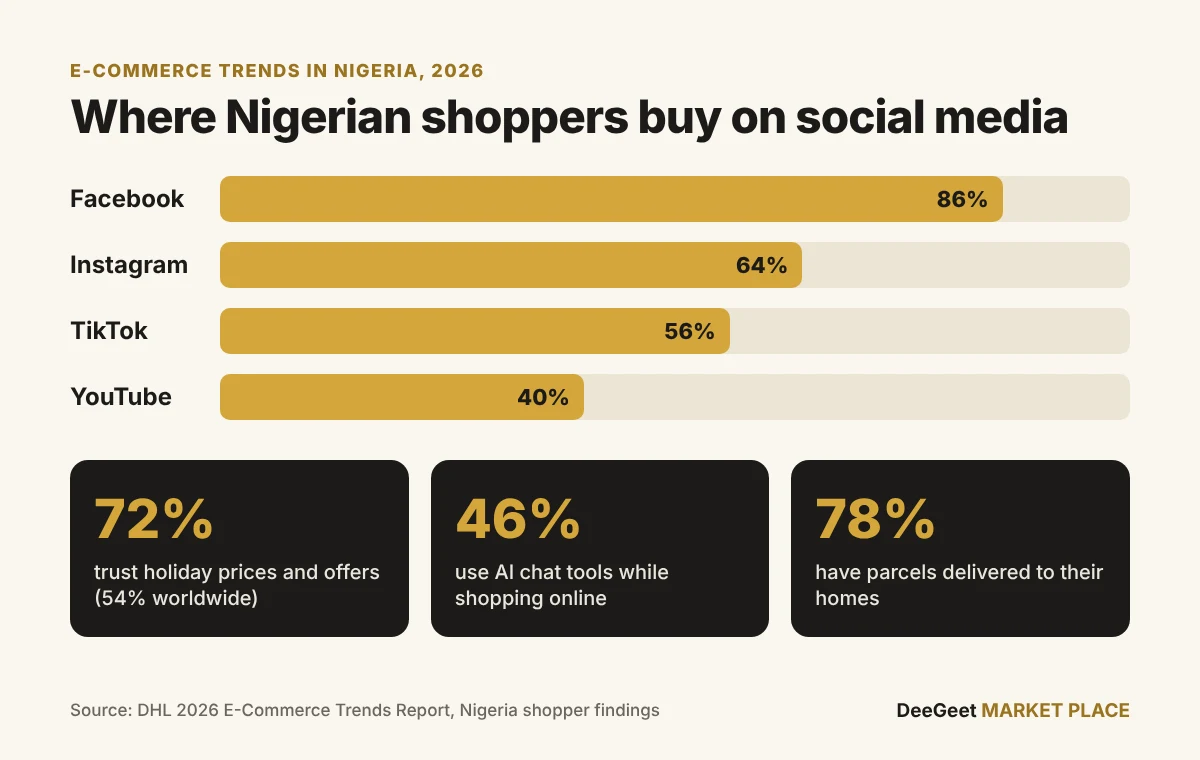
Nigerian shoppers in the DHL survey named Facebook (86%), Instagram (64%), TikTok (56%) and YouTube (40%) as the social platforms they buy through. Worldwide, 63% of businesses sell on social media, yet only 45% of shoppers buy there.
In addition, many sales across Africa end in a chat. First, a seller posts a product on Instagram or TikTok. Then the buyer and the seller agree the price and payment in a WhatsApp conversation, as TechTrendsKE describes.
4. Live video is becoming the proof buyers ask for
Globally, live shopping events influence 30% of shoppers, and 29% of shoppers have bought something through YouTube. After all, a shopper buying from a phone cannot touch the product. A short, unedited video, however, shows the true colour, the stitching and the sole.
For this reason, live product videos were the feature DeeGeet Market Place customers asked for most. Listings such as these navy knit running sneakers now show a live video beside the photos.
5. AI chat tools are entering the buying journey
Nigeria ranks fourth of the 29 countries for using AI chat tools while shopping, at 46% of shoppers. Likewise, 88% of Nigerian businesses already use AI across their online stores, and 94% expect to use more of it within five years. Globally, 29% of shoppers say they would let AI make purchases for them within five years. However, privacy, trust and security remain the top concern, named by 58% of shoppers.
6. Instant bank transfers keep climbing
NIBSS data show that its instant payment platform handled 11.2 billion transactions, up 120% from 2022, THEWILL reported on 16 November. Moreover, analysts expect another rise in electronic payments as the year closes.
Payment choice also affects sales. Globally, 62% of shoppers abandon a purchase when a store does not accept their preferred payment method.
7. Delivery and returns decide who gets the order
In the DHL survey, 78% of Nigerian shoppers have parcels delivered to their homes. Across the world, 7 in 10 shoppers will not buy from a brand whose delivery and returns they do not trust. Also, 67% have abandoned a cart because of the delivery offer. In Nigeria, faulty or poor quality items are the main reason shoppers return goods, at 78%.
How easing inflation affects these e-commerce trends
Headline inflation fell to 14.63% in September from 15.39% in August, the fourth monthly decline in a row, Nairametrics reported. However, food inflation stayed high at 19.59%, and core pressures rose, according to Vanguard.
Looking ahead, Coronation Research expects October inflation to ease to 13.59%. In short, prices are still climbing, only more slowly. So a genuine discount still makes a real difference to a household budget.
What these e-commerce trends mean for shoppers
- Compare prices across the whole season instead of buying in a rush on 27 November.
- Ask for a live video of the exact item before you pay, especially for shoes, clothing and electronics.
- Confirm the account name before every bank transfer, and keep your receipt and the chat with the seller.
What they mean for sellers
- Publish clear prices and the true former price for every discounted item.
- Show each product in a short, honest video taken in good light.
- State your delivery time, delivery cost and returns rule on every product page.
Browse the latest listings on DeeGeet Market Place, many of them with live videos, and compare prices well before 27 November. For more buying advice, read our news and guides.